Roberts Supreme Court Majority Submits to Trump’s “Unitary” Constitution
During his Senate confirmation hearing in 2005, Chief Justice John Roberts committed “to protect the independence and integrity of the Supreme Court,” and “to ensure that it upholds the rule of law.”
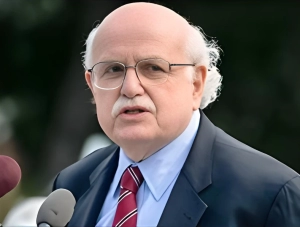
Twenty years later, he has not lived up to his promises.
Roberts is smart and skilled. He must know that Trump is an aberrational President. After all, Trump is taking the steps that autocrats all over the world take. Roberts must know that Trump is grossly abusing the powers of his office, including by instructing the Justice Department and the FBI to investigate, prosecute and jail his political opponents.
However, to date, Roberts has refused to engage with this, instead he sits passively on the sidelines. He and the five other Justices in the majority – all appointed by Republican presidents – have refused to take account of what is plainly before their eyes – Trump is stretching his power far beyond the Constitution and federal laws.
Roberts has long believed in the “unitary” presidency. This is an interpretation of the Constitution that places in the president direct, total control over the entire executive branch: every agency, every employee, every function.
But President Trump has an even more expansive view of his authority. He wants a “unitary” Constitution.
Trump wants to control not just the entire executive branch, but also, in practical terms, the legislative and judicial branches of our Constitutional system. While the unitary presidency is a fundamental departure from our nation’s norms, Trump’s approach of creating a unitary constitution represents an autocracy or dictatorship. Trump is well along to achieving this for his first ten months in office.
The Republican-controlled Congress salutes and says, “Yes sir,” every time Trump wants something. Roberts and his Republican-appointed majority on the Court appear happy to shut their eyes, minds, and souls to Trump’s power grabs and authoritarian ways.
Lower court federal judges, however, appointed by both Republican and Democratic presidents, including Trump, have not gone along. They repeatedly have made initial findings that Trump and his administration are violating laws and ignoring Constitutional limits. They have been issuing injunctions and temporary restraining orders while their cases continue.
But almost every time the Trump administration gets these cases to the Supreme Court, on an expedited basis, the administration wins, and lower court judges and the American people lose.
These cases are reaching the Supreme Court through the use of the “Emergency Docket” also known as the “Shadow Docket.” This is a process that allows parties to apply for fast-track appeals to the Supreme Court. The Court has been accepting the administration’s requests regardless of whether “emergencies” exist.
As of October 2, according to Reuters, the Trump administration had won, fully or partially, 21 of 23 Emergency Docket cases.
In theory, the Supreme Court is simply lifting injunctions while the cases move forward. In practice, the Court is allowing the administration to proceed with its actions and to frequently accomplish much, if not all, of its often-dubious goals. Meanwhile, the cases could take years before they are resolved on the merits.
Justice Elena Kagan, in her dissent in Trump v. Slaughter, captured what the administration and Roberts majority is doing with their use of the Emergency Docket. According to Kagan, “Our emergency docket should never be used, as it has been this year, to permit what our own precedent bars. Still more, it should not be used, as it also has been, to transfer government authority from Congress to the President, and thus to reshape the Nation’s separation of powers.”
There are at least five profoundly important cases that the Supreme Court may have to resolve in its current term.
They involve issues of enormous importance, including whether Trump’s tariffs are an illegal usurpation of congressional power, whether the Impoundment Control Act protecting the congressional power of the purse is unconstitutional, whether it is illegal for Trump to federalize and deploy National Guard soldiers to roam the streets of blue cities, whether Trump’s attack on birthright citizenship is unconstitutional and whether the landmark Voting Rights Act is completely dismantled after 60 years of serving American voters.
When we know how the Roberts Supreme Court majority deals with these profound issues, we will know just how complicit they are with this president/wannabe king. We will see whether the Roberts majority retains any of the independence granted to them by the Constitution or have indeed fully capitulated to Trump and turned the judicial branch over to his practical control.
___________
Fred’s Weekly Note appears on Thursdays in Wertheimer’s Political Report, a Democracy 21 newsletter. Read this week’s newsletter, and other recent editions, here. And subscribe for free here and receive your copy each week via email.